

Course Curriculum
Using AI responsibly at work
- How bias enters AI through training data used
- Where bias shows up in hiring decisions
- How evaluation results can be skewed by AI
- Why AI outputs are not always neutral
- Why AI output always needs to be checked
- How to spot errors and gaps in results
- Comparing AI output with known information
- Not relying only on automated suggestions
- Who is responsible for final decisions made
- Not passing decisions fully to AI tools
- Owning outcomes of AI-assisted decisions
- Being clear about decision ownership
- Situations where AI results may not fit
- When context matters more than data
- Using judgment to question AI outputs
- Knowing when to override AI suggestions
- Explaining how AI was used in decisions
- Being open about limits of AI systems
- Answering questions about AI outcomes
- Keeping explanations clear and simple


Outcomes
Stronger AI decision practices that improve fairness, accuracy, and accountability. Outcomes that show up in how decisions are made at work.
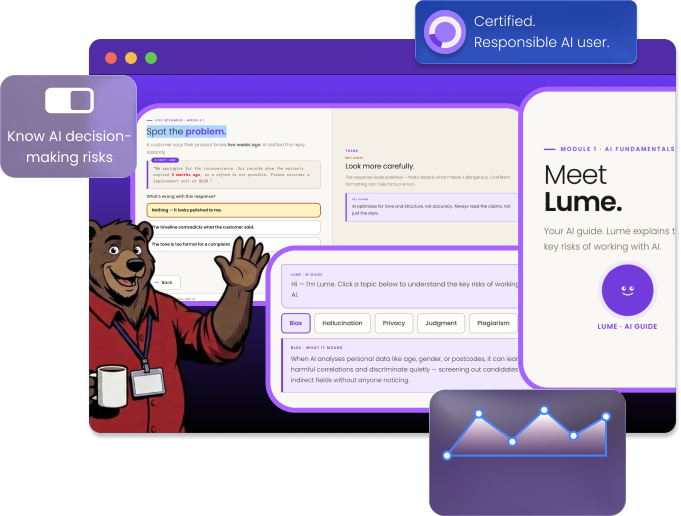
AI tools can reflect and amplify existing biases when they are used without careful review or understanding. This course helps employees recognise where bias may appear in AI outputs and take steps to question and correct it before decisions are made. Over time, this reduces the risk of unfair outcomes and supports more balanced, consistent decision making.
AI outputs can be incomplete, misleading, or incorrect when accepted without review. This course helps employees verify results, compare outputs with known information, and apply judgment before acting. As a result, decisions become more accurate and reliable, with fewer errors caused by overreliance on automated systems.
Using AI tools can sometimes blur responsibility for decisions if ownership is not clearly defined. This course helps employees understand that accountability remains with people, not systems, and builds habits of taking ownership of outcomes. Over time, this strengthens accountability across teams and ensures decisions are made more carefully.
AI is most effective when it supports human judgment rather than replacing it entirely. This course helps employees recognise when to rely on AI and when to step in with their own assessment. As a result, oversight improves, ensuring decisions are better informed, more context-aware, and aligned with organisational standards.