

Course Curriculum
Five skills to close the gender AI gap
- The scale of the gender AI adoption gap
- Why trust and transparency concerns run deeper
- How AI design shapes who feels welcome to use it
- What hesitation signals and how to respond to it
- What the competence penalty is and how it works
- How AI use is judged differently across genders
- Where the competence penalty shows up in practice
- How managers can work to counteract this bias
- What psychological safety around AI looks like
- How fear of failure limits female AI adoption
- How to build safety around AI use at work
- How leaders signal that AI experimentation is safe
- Why risk perception differs along gender lines
- How risk framing affects who adopts AI at work
- Reframing AI as safe to explore and get wrong
- What organisations can do to address this gap
- What a gender-inclusive AI workplace looks like
- How workplace norms shape AI adoption patterns
- Making AI adoption feel normal for everyone
- Measuring progress on closing the gender AI gap


Outcomes
Equity in AI adoption at work. Outcomes in a reduced adoption gap, improved AI confidence, higher productivity, and reduced competence penalties.
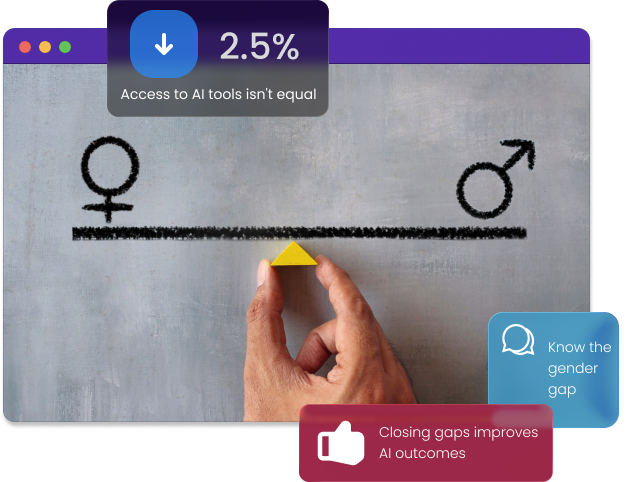
The 25% gap in AI adoption between men and women is not inevitable. It reflects structural barriers, design choices, and cultural norms that can be identified and changed. This course gives organisations the understanding and tools to address each of those factors, so AI adoption becomes more equitable and the career and economic consequences of the gap begin to close.
Confidence with AI tools does not develop in a vacuum. It depends on whether people feel safe to try, safe to fail, and free from the risk that using AI will be used against them. This course builds the conditions that make confidence possible for women in the workplace, helping organisations create environments where experimentation is genuinely welcome and where progress is recognised without a penalty attached.
When a significant portion of any workforce holds back from tools that improve output and efficiency, productivity suffers at every level. Closing the gender gap in AI adoption means more of the team is working with the full range of available tools, contributing at their potential, and not spending energy managing the risks of visibility. The result is a more productive and more equitable workplace.
Women who use AI-assisted work face a measurable competence penalty that men largely do not. This course helps managers and leaders identify where that bias is operating, challenge the assumptions that drive it, and build evaluation practices that assess contribution fairly regardless of which tools were used to produce the work.